

The Made-up Man
When Love Becomes a Blueprint Instead of a Bond


When you stop mourning the man he never was and started reclaiming the woman you have always been.
The relationship may not have been long. There may not have been betrayal. He may not have lied. He may simply have been emotionally limited, inconsistent, or honest about not being ready. And yet when it ends, so does the world around you. You are not only grieving the man who stood in front of you. You are grieving the man you believed he would become.
I see this often in my therapy room and with friends. A woman will sit across from me and speak clearly about what did not work. She will describe the missed calls, the ambiguity, the hesitations. She will tell me she knows he showed her who he was. She will even say she understands why it could not continue. Then her body will change when she speaks about the future she imagined. Her shoulders round. Her eyes soften. Her voice catches when she mentions the life they would have built. The home. The rituals. The mornings. The version of him who would one day have turned toward her and chosen her fully. That is where the grief lives.
It is not the loss of the relationship as it was. It is the loss of the narrative she had already begun to inhabit.
Recently, I wrote a song about this dynamic. Writing lyrics has become one of the ways I work with attachment grief, both personally and clinically. I shape the emotional truth into language and melody, and I use AI to create the singing and the music, as that’s not my skill!
When we play the song in therapy, something happens that rarely happens through dialogue alone. The woman who has been explaining her heartbreak begins to feel it move. Her breathing shifts. Her posture changes. Sometimes she stands. Sometimes I stand with her. Sometimes we sing together. We sway. Occasionally, we laugh through tears at the honesty of a line. And then the tears come fully, as release.
To understand why this works, we have to understand both attachment and the brain.
Falling in Love With Potential: The Predictive Brain at Work
Human beings do not fall in love with static data. We fall in love with trajectory. The brain is fundamentally predictive. One of its primary functions is to anticipate what will happen next based on available cues. When someone shows us warmth, ambition, tenderness, or growth, even intermittently, the brain extrapolates. It constructs a likely future.
This predictive process involves the prefrontal cortex, which helps with planning and imagining future scenarios. It also involves the hippocampus, which contributes to memory and simulation. When we imagine a shared future, many of the same neural circuits activate as when we experience something in real time. The body begins rehearsing the life we envision. This is why imagined futures feel embodied.
When attachment insecurity is present, this predictive system can intensify. Anxious or preoccupied attachment develops in childhood when caregivers are inconsistent. The child cannot reliably predict when comfort will arrive. As a result, the nervous system becomes hyperattuned to cues of availability and withdrawal. The child learns to work for connection. Love feels conditional and uncertain.
In adulthood, anxious attachment often presents as heightened sensitivity to relational shifts, fear of abandonment, and a tendency to overinvest in preserving connection. The person may interpret ambiguity as a challenge to solve rather than a boundary to respect. They may believe that if they love well enough, wait long enough, or adapt carefully enough, the relationship will stabilise. This is not pathology. It is adaptation.
When someone with anxious attachment encounters a partner who is emotionally unavailable or inconsistent, the dynamic can become neurologically charged. Intermittent reinforcement strengthens attachment. Dopamine, which is involved in anticipation and motivation, increases not only when we receive reward, but when we anticipate it. Unpredictability amplifies this anticipation. Each “almost” feels meaningful. Each “someday” feels sacred. Potential becomes an intoxicating pill.
You are not only bonding to the man. You are bonding to the predicted version of him. The imagined future becomes neurologically encoded.
The Role of the Limbic System and Projection
Projection is often misunderstood as delusion. In reality, projection is a coherence strategy to make meaning of situations where confusion resides. The limbic system, which includes structures such as the amygdala and hippocampus, processes emotional salience and memory. When behaviour is inconsistent, the limbic system searches for patterns. Ambiguity is stressful. The brain prefers a coherent narrative.
If he is affectionate one day and distant the next, the mind attempts to reconcile those realities. It may conclude that he is wounded but growing, hesitant but capable, not ready yet but almost there. These interpretations reduce cognitive dissonance. Cognitive dissonance refers to the discomfort that arises when conflicting information exists simultaneously. Constructing a hopeful narrative restores internal stability.
Over time, the narrative becomes embodied. The imagined life is rehearsed in neural circuits. The attachment bond incorporates not only who he is, but who he might become. When the relationship ends, the body grieves both.
How We Lose Ourselves in the Process
Losing the self in someone else does not happen in an instant. It unfolds through small adjustments. You soften your needs. You reinterpret his distance generously. You reassure yourself that patience is maturity. You minimise your discomfort to preserve the possibility.
Gradually, your internal orientation shifts. Your worth becomes entangled with his readiness. You cling to the most loving version of him and treat it as the truest one. Your nervous system orients around his potential rather than your lived experience.
Neuroscience explains why this feels so destabilising when it ends. When we attach, neural representations of self and other overlap. The medial prefrontal cortex, involved in self-referential processing, activates similarly when thinking about ourselves and a close partner. The brain partially incorporates the partner into the sense of self.
If that incorporation includes an imagined future, the loss requires neurological reorganisation. The brain must update its predictive models. The body must relinquish rehearsed experiences that never materialised. That is not a small task.
Why Singing and Dancing in Therapy Work
When I introduce the song in session, I do so collaboratively. Sometimes I work together with a client but often they cannot find the words as they are immersed in the experience, so I invite them to allow me to draft something as a therapeutic intervention. I might say, “I can write some lyrics that speak to this dynamic or let them know I already have a song, if that’s the case. We sit together. Sometimes we both remain seated at first. As the song progresses, I watch her breathing. If she begins to soften, I may invite her to stand with me. I model gentle swaying. I sing along quietly or hum. Sometimes we sing louder. This is not performance. It is co-regulation.
Co-regulation refers to the process by which one nervous system helps stabilise another. My steady voice, my paced breathing, my grounded presence signal safety. When we sing together, our breathing synchronises. Rhythm entrains the nervous system. Entrainment is the process by which biological pacing align with external beats. Music provides predictable timing, which calms the amygdala and reduces threat activation.
Singing extends the exhale, which stimulates the vagus nerve. The vagus nerve connects the brainstem to the heart, lungs, and digestive tract. It plays a central role in the parasympathetic nervous system. When vagal tone improves, heart rate variability increases, which is associated with emotional flexibility and resilience.
Vocal vibration also stimulates the muscles of the throat and larynx, which are linked to vagal pathways. The body shifts from sympathetic activation, associated with fight or flight, toward parasympathetic regulation.
Dancing or swaying introduces bilateral movement. Bilateral stimulation engages both hemispheres of the brain rhythmically. This supports integration between language centres in the left hemisphere and emotional processing centres in the right hemisphere. Emotional memories, often stored somatically and implicitly, begin to integrate with explicit narrative memory.
This is what I mean by embodied narrative. The story is no longer just told. It is felt, processed, and reorganised in the body.
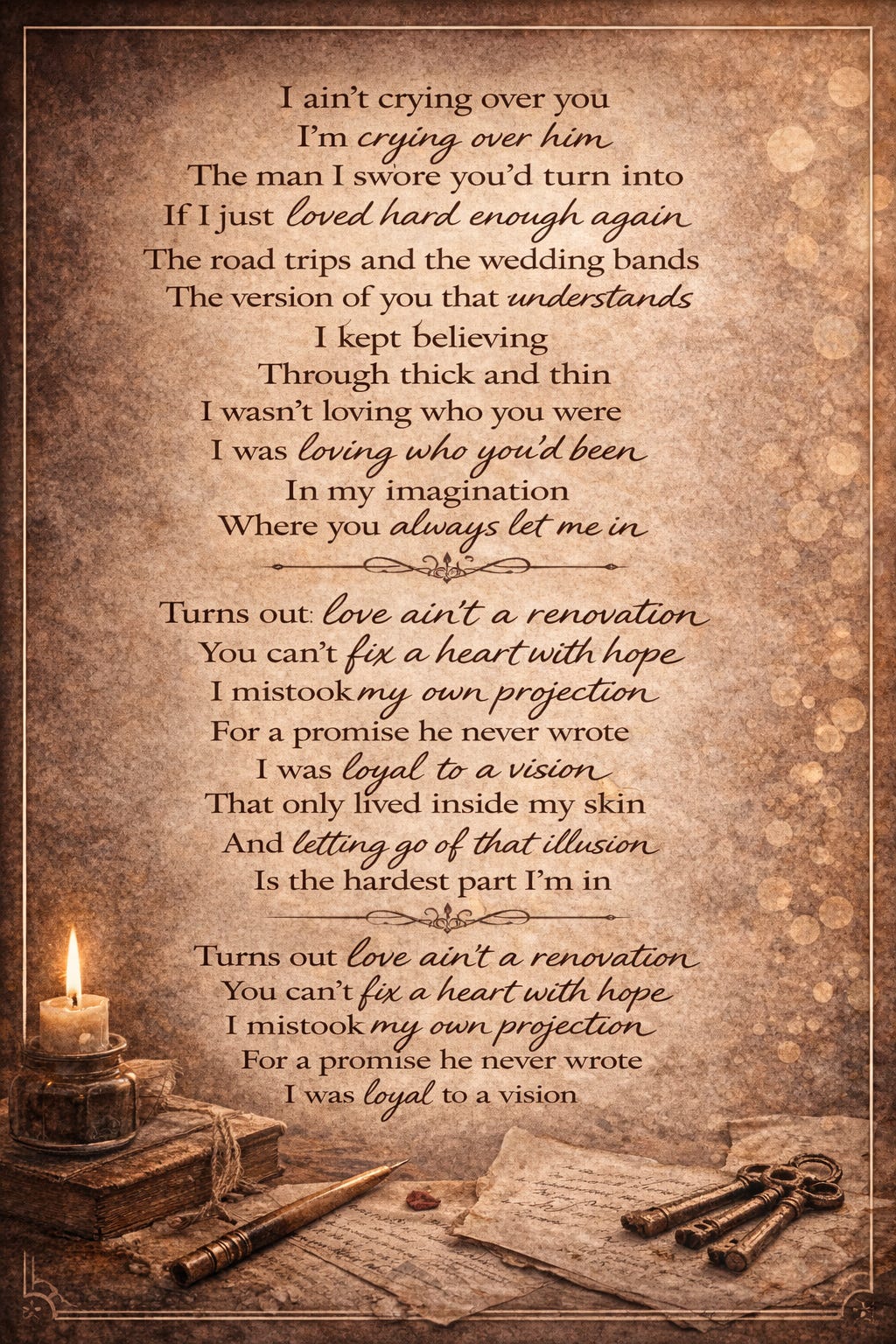
This song “I ain’t crying over you,” (click the link to listen) I have used with a number of clients. When they sing or hum the chorus, “I ain’t crying over you, I’m crying over him,” the repetition allows the distinction to settle neurologically. The limbic system begins updating its emotional map. The imagined man is separated from the real one. Precision reduces shame. The grief becomes specific to the hope of what he could be.
Tears often emerge at this point, because her nervous system feels safe enough to release stored anticipation. The rehearsed future dissolves in real time. Here are the full lyrics of the song I use for this kind of work.


The Power of Meaning and Coherence
Healing requires coherence. Coherence refers to the integration of emotion, memory, and meaning into a stable narrative. When trauma or attachment rupture occurs, the narrative fractures. There is what happened, what was imagined, and what was hoped for. Music helps braid those strands together.
The final verse of the song shifts toward self-forgiveness. That shift is essential because shame can freeze integration. Shame activates threat circuitry and narrows perspective. When she sings about forgiving herself, the medial prefrontal cortex engages in self-referential compassion. The narrative updates. She is no longer the foolish girl. She is the adaptive woman who loved with the attachment template she carried.
As the song ends and there is silence, there is often a visible change. Her posture is more upright. Her breathing is steady. The blueprint she had been clutching is loosening. She is not only grieving him. She is disentangling from the imagined future and reclaiming the self that was woven into it.
When that happens through breath, rhythm, movement, and meaning combined, the healing is not intellectual. It is embodied. And embodied healing is what lasts.
Paid subscribers can get the resource: Reclaiming Yourself From the Imagined Man, A guided embodied integration practice.
If you are woman who recognises yourself in this process and finds that integration happens more easily in shared spaces, I have just started a free community on Skool called The Feminine Field. It is a quiet, reflective space for sensitive and neurodivergent women who are interested in weaving psychological understanding with spiritual awareness, embodiment, and nervous system safety. There is no pressure to perform, participate constantly, or be a certain way. It exists as a place to land, reflect, and gently explore what it means to live with more attunement to the body, intuition, and inner rhythms, alongside others who understand that depth and sensitivity are not things to fix, but capacities to work with . Click the image below to join.

This kind of trauma is what I hold space for on my Beyond Betrayal retreat - coming up next year. Not only the betrayals of partners or friends, but the more covert, bone-deep ones, the ones that happen in childhood, under the guise of care. When love is conditional on illness, when attention comes only through suffering, when truth is gaslit by those meant to protect you, the wound goes deeper than words. At this retreat, we don’t just name what happened. We disentangle love from control, care from harm, and begin the slow, embodied process of trusting ourselves again. This is where we reclaim the right to feel well, to be free, and to belong to our own body. Even and especially when we were taught that wellness was a threat.
At my Beyond Betrayal Retreat, we explore the hidden places where the wound lingers, not just in memory, but in behaviours.
We ask:
What are you holding onto… that is holding you hostage?
What would it mean to let go on your own terms?
How can we make meaning out of what felt meaningless?
If you’ve found yourself surrounded by things but starved of safety, this retreat is your invitation to come home — not just to your body, but to your voice, your boundaries, and your worth.
It’s not about blaming the past, it’s about coming back to the one who was silenced: you.
It’s where we stop echoing other people’s stories and start listening to our own.
Through guided somatic work, storytelling, ritual, and re-mothering practices, we will gently call back the voice that learned to stay quiet in order to stay safe.
We’ll move through the nervous system imprints of betrayal not just relational betrayal, but the betrayal of self-abandonment and begin the sacred process of re-alignment.
If this article stirred something in you… if you felt the ache of recognition… if your voice still trembles when you speak your truth, then this retreat is for you.
In 2026, I’m opening sacred space for those ready to step out of the story of betrayal and into something deeper: truth, repair, and return.
We’ll gather in the Scottish Highlands among lochs, firelight, and fierce tenderness, to release what you were made to hold, and remember who you were before the rupture.
This isn’t just healing. It’s retrieval.
If your heart whispered “yes” as you read this, you’re invited.
🜂 Register your interest now and be the first to receive the early details when doors open. Click the image below to find out more and let the wilderness hold what the world tried to silence.

If you would like more help on rewriting your script and are open to working at all energetic levels (physical, mental, emotional and spiritual) check out my Shamanic Scripting programme that integrates evidence-based psychology with spiritual healing practices. Click the image below to find out more:

If you don’t want to commit to a subscription consider buying me a coffee to help me help others in my work.
If you would like to read other areas that I write upon I invite you to check out my Rewrite Room where a collection of my most recent articles can be found. Click the image below to enter.

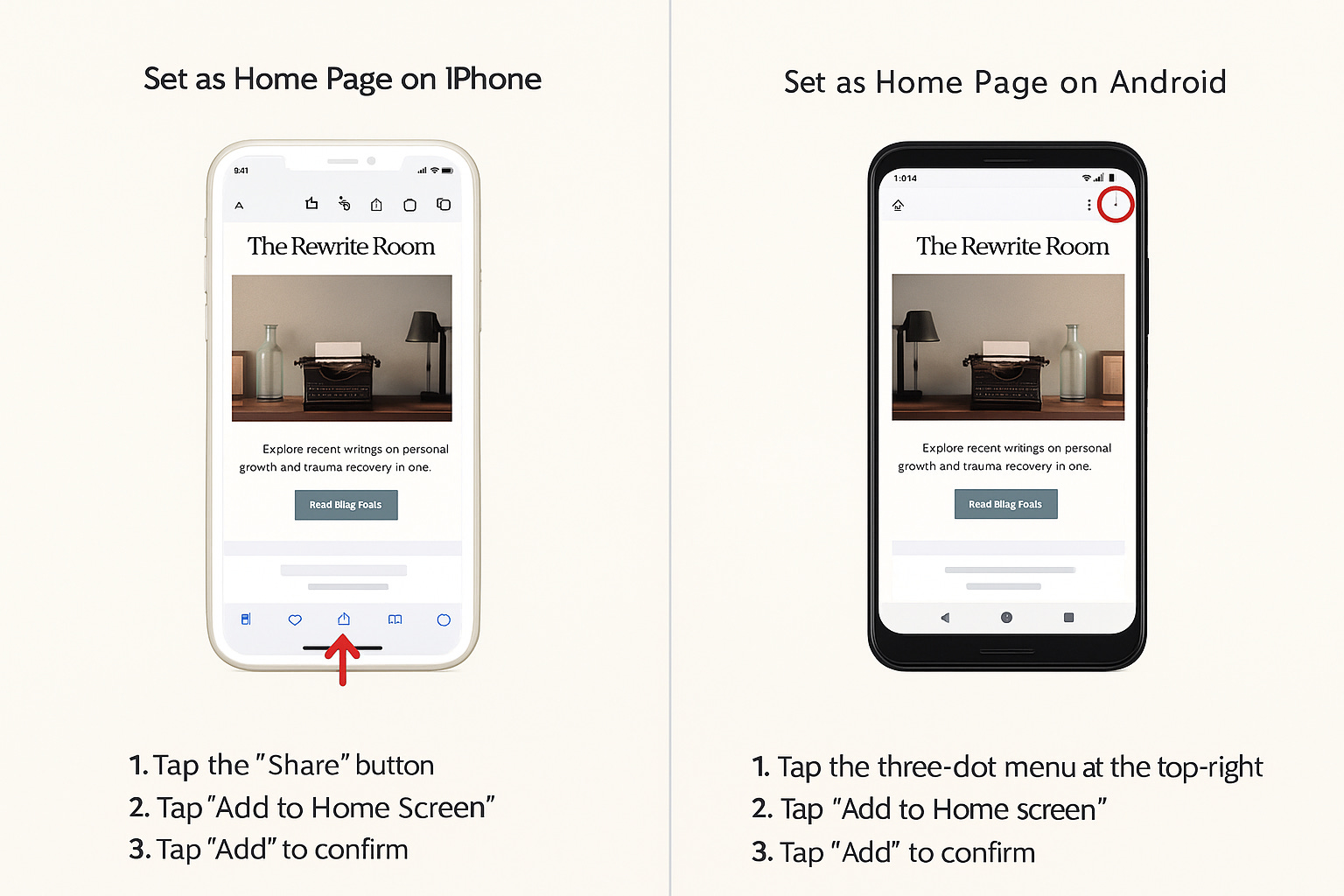
The Rewrite Room is the easiest place to find all of my recent writing in one grounded space. Every new article I publish on Substack and Medium arrives here automatically, so you always have a single doorway to return to. If you enjoy reading my work and want an easy way to reconnect without searching through apps or platforms, you are welcome to keep this page close. Many readers choose to make it their home screen so they can step into this space with one tap. Below is a simple guide on how to do that on iPhone and Android.
To continue to reconnect with your body more and remain mindful and present see if any of these online courses from Rewire Trauma Therapy resonate with you:
Paid subscribers see my code below for 50% off courses over $240 dollars.
Somatic Therapy Programme Link
Expressive Arts For Trauma Healing Programme Link
Healing Trauma-Based Addiction Programme
Healing Trauma Through Sound And Music Programme Link
Nutrition For Trauma ProgrammeLink
Healing Trauma-Based Eating Disorders Programme Link
Trauma-Informed Yoga Programme Link
Healing Trauma Through Movement And Dance Programmme Link
Healing Trauma With Qigong Programe Link
Martial Arts For Trauma Healing Programme Link
Healing Chronic Fear Programme Link
Healing From Narcissistic Abuse Programme Link
Healing From Sexual Abuse And Reproductive Trauma Programme Link
Healing Trauma Through Sleep Programme Link
Psychedelic-Assisted Trauma Therapy Programme Link
Reparent your Inner Child to work on Underlying Trauma
Click the image below to download a self-print
Inner Child Journal for £3.99
