

Survival Empathy: From Absorption to Embodied Awareness
Why “I Feel Other People’s Emotions” Needs a Deeper Conversation


When another person’s emotion hits your body hard, it may not only be empathy. It may be an attachment alarm asking, “Are we still safe?
In many spiritual, therapeutic, and healing circles, there is a status attached to being the person who “feels everything.” Someone may describe themselves as an ‘empath, a sensitive, an intuitive’, or someone who absorbs other people’s emotions, and the phrase can carry a kind of spiritual credibility. It suggests openness, depth, compassion, and a refined ability to sense what others miss. In some spaces, the more intensely someone feels another person’s grief, anxiety, anger, sadness, or pain, the more gifted they are perceived.
There is some truth to this. Some people really are highly sensitive to the emotional and energetic field around them. They may walk into a room and immediately sense tension, grief, agitation, sadness, guardedness, or disconnection. They may sit beside someone and feel pressure in the chest, a drop in the stomach, buzzing in the body, or a sudden wave of emotion that seems to arrive from nowhere. From a spiritual perspective, this may be understood as energetic perception. From a psychological perspective, it may be understood as attunement to subtle cues, such as micro-expressions, tone, posture, breath, rhythm, and relational signals. From a neurobiological perspective, it may involve a highly responsive nervous system that is skilled at detecting social and emotional information.
These explanations do not have to compete with one another. A person can be spiritually sensitive and psychologically attuned. They can perceive energy and also have a nervous system shaped by early relational experience. They can notice real emotional information and still need to interpret it carefully. The deeper question is not whether sensitive people feel something but whether they know what the feeling means.
This is where many discussions about empathy become too simple. We often treat intensity as evidence. If I feel something strongly, I assume it must be true. If I feel shame around someone, I assume they are judging me. If I feel anxiety in a conversation, I assume something is wrong. If I feel someone’s sadness, I assume they need me to help. Yet intensity and accuracy are not the same thing. A sensation may be real without being a reliable interpretation. The body may be giving us information, but it may not yet be telling us whether that information belongs to the other person, to us, to the relationship, to memory, or to the energetic field between us.
The aim, then, is not to become less empathic but to become more accurate. The work is not to dismiss sensitivity, intuition, or energetic perception. It is to refine them. The question is not simply, “Am I feeling something?” It is, “What am I feeling, where does it come from, and what does it actually mean?”
When Sensitivity Becomes a Survival Strategy
Survival empathy often begins long before a person has any language for trauma, intuition, spirituality, or nervous system regulation. It begins in the body of a child who has to read the emotional state of others in order to feel safe. This may happen in homes where anger is frightening, sadness pulls the child into a caregiving role, silence means withdrawal, love is inconsistent, criticism is unpredictable, or the emotional needs of adults dominate the room. It may also develop in children who were bullied, excluded, shamed, parentified, or made responsible for keeping the peace.
The child does not consciously decide to become empathic. The child adapts. Their nervous system learns that other people’s feelings matter because those feelings have consequences. If a parent is angry, something may happen. If a parent is sad, the child may need to comfort them. If a parent is anxious, the whole home may feel tense and unbearable. If a parent withdraws, the child may feel abandoned. If a parent is disappointed, love may feel at risk.
Over time, the child’s attention moves outward. They learn the face before they learn the self. They learn tone, silence, movement, and relational charge before they learn how to ask, “What do I feel?” This is a sophisticated survival strategy. The child becomes skilled at noticing what might keep them connected, accepted, useful, wanted, or safe.
The difficulty is that a survival skill can later be mistaken as a personality trait. The adult may say, “I have always been an empath,” without realising that part of their empathic identity was formed in conditions where they had to monitor others before they could rest in themselves. They may be genuinely sensitive, but their sensitivity may also be carrying a history of emotional responsibility. They may know what everyone else feels before they know whether they are tired. They may detect another person’s disappointment before they notice their own resentment. They may sense sadness in someone else before they realise they have no capacity left to hold it.
This is the first key distinction: Survival empathy is not simply feeling deeply. It is feeling deeply through a nervous system that once had to monitor connection for safety.
Empathy Carrying an Attachment Alarm
Survival empathy is empathy carrying an attachment alarm. This explains why this form of empathy feels so urgent.
An attachment alarm is the body’s warning system around relational safety. For a child, connection is not a luxury. It is survival. A child cannot simply leave an unsafe emotional environment, choose a new family system, or regulate alone. The child needs the adults around them to be available enough, predictable enough, and emotionally safe enough. When that does not happen, the child’s body learns to monitor connection closely.
This means that later in life, emotional cues may not be experienced as neutral information. A shift in tone may not feel like a shift in tone. It may feel like the beginning of withdrawal. A tired facial expression may not feel like tiredness. It may feel like disappointment. Silence may not feel neutral. It may feel like punishment. Someone else’s sadness may not remain someone else’s sadness. It may feel like a call to become useful so the relationship does not collapse.
The person may genuinely be sensing something, but the sensing is carrying an extra charge. Their body is not only asking, “What are they feeling?” It is asking, “Are we still safe? Am I still loved? Have I done something wrong? Do I need to repair this? Do I need to become smaller, softer, more helpful, more pleasing, more available, or less honest?”
This is why survival empathy can be so compelling. It is not just perception. It is perception plus relational alarm. The sensitivity may be real, but it is travelling through an old warning system. Until that warning system is recognised, the person may believe they are reading another person clearly when they are also reading their own history.
The Hidden Cost of Being the Emotional Receiver
One of the less discussed consequences of survival empathy is that the person often becomes the emotional receiver in their relationships. They may become the one who notices what is unspoken, carries what others avoid, senses tension before it is named, and feels responsible for restoring ease. In families, friendships, workplaces, and healing spaces, they may be drawn into the role of interpreter, mediator, rescuer, emotional translator, or silent container.
At first, this role can feel meaningful. It may bring praise, closeness, and a sense of purpose. People may say, “You always understand,” or “I feel better after talking to you,” or “You just know what I need.” For someone whose early life taught them that connection came through usefulness, this can feel like belonging. Being needed can become confused with being loved.
Over time, though, the cost appears. The emotional receiver may become exhausted by feelings that were never theirs to hold. They may feel resentful without knowing why. They may dread certain people, not because they lack compassion, but because their body expects to be used as an emotional container. They may leave interactions feeling foggy, heavy, anxious, guilty, or depleted. They may also lose access to their own signals because their attention has been trained to move outward so quickly.
This is where survival empathy can become self-erasing. The person may be deeply attuned to others, yet strangely absent from themselves. They may know how to read a room but not how to read their own hunger, anger, tiredness, desire, limit, or when they want to say ‘no’. This is not because they are empty. It is because their attention has been shaped by attachment survival. The self did not disappear. The volume became low, because other people’s feelings became louder.
Absorption: When Feeling Becomes Ownership
Absorption happens when another person’s emotion appears to enter the body so completely that the boundary between self and other becomes blurred. The other person’s sadness becomes heaviness in the chest. Their anxiety becomes racing thoughts. Their anger becomes fear. Their disappointment becomes shame. Their withdrawal becomes abandonment panic. Their grief becomes an immediate urge to rescue.
Absorption often feels like empathy because it is intense. It may feel spiritual because it seems to happen beneath words. It may feel loving because the person is deeply affected. It may feel meaningful because the body is giving strong signals. Yet absorption is not the same as clear empathy. Absorption collapses the space between sensing and owning.
This is the point at which many sensitive people become confused. They may think, “I feel their sadness,” when their body may actually be responding to sadness with an old fear of responsibility. They may think, “I feel their anger,” when their nervous system may be remembering what anger once meant. They may think, “I feel their need,” when their body may be activating an old role of rescuer, mediator, peacekeeper, or emotional container.
The problem is not that they are feeling something. The problem is that absorption can make it hard to know what kind of something it is. It may be the other person’s emotion. It may be the sensitive person’s body memory. It may be a shared relational field. It may be an intuitive impression. It may be a projection (combing from the receiver’s unconscious and being projected out at the other, as if it belongs to them, out of awareness). It may be an attachment alarm. It may be several of these woven together.
This is why absorption is so seductive and so unreliable. It gives the feeling a sense of certainty before the person has understood its source.
Awareness: When Feeling Becomes Information
Awareness begins when the person can notice the sensation without immediately becoming it. Awareness recognises that the body is responding, but it does not turn the response into instant certainty. It creates a small but powerful space between the feeling and the interpretation.
A person in awareness might think, “I feel tightness in my chest around this person, and I wonder whether I am sensing their sadness, reacting to my own old fear, or noticing something in in the dynamic between us that needs more careful attention.” That kind of inner sentence does not dismiss the sensation. It also does not obey it blindly.
This is the difference between absorption and awareness. Absorption says, “I feel this strongly, so it must be true.” Awareness says, “I feel this strongly, so I need to become more grounded before I decide what it means.” Absorption says, “This emotion is in me, so it must be mine to manage.” Awareness says, “This emotion is near me or moving through me, but it may not belong to me.”
Awareness does not make sensitivity less spiritual. It makes it clearer. It allows sensitivity to become more accurate because the person is no longer treating every internal reaction as evidence about someone else. It allows the empathic person to remain open while also becoming discerning. It allows the body to become a source of information rather than a place where every feeling must be stored. Feeling everything is not the goal. This is all about feeling clearly.
Why Activation Can Masquerade as Intuition
One of the most important reasons survival empathy becomes confusing is that activation can masquerade as intuition. The body reacts quickly, and because the reaction is strong, it can feel like knowing. The person may say, “I just know something is wrong,” or “I can feel they are annoyed with me,” or “I know they need me,” or “I can sense they are pulling away.” Sometimes they may be right. Sensitive people often do notice real cues. However, the strength of the feeling does not prove the accuracy of the interpretation.
The nervous system is predictive. It does not only respond to the present moment. It uses past experience to anticipate what may happen next. This is why a small cue can produce a large reaction. A delayed reply can activate abandonment fear. A serious facial expression can activate shame. A raised voice can activate fear. Someone’s sadness can activate the old role of rescuer. A group dynamic can activate memories of exclusion. A person’s emotional intensity can activate the child-self who once had to manage an adult’s dysregulation.
When the nervous system is activated, the body may respond before the thinking mind has time to evaluate what is actually happening. The person may feel urgency, tension, agitation, or an impulse to fix. They may also shift into shutdown, where they feel numb, heavy, foggy, ashamed, or unable to speak. In either case, the body produces a strong signal, and the mind then tries to explain it.
This is why activated empathy can feel so convincing. The mind treats the strength of the signal as evidence. Yet the signal may be a mixture of present perception and past memory. The person may be sensing something real, but they may also be adding old meaning to it.
In spiritual language, we might say the energetic channel becomes clearer when the body is regulated. In psychological language, we might say perception becomes less distorted by attachment fear. In neurobiological language, we might say the person has enough nervous system steadiness for reflective processing to remain available. These are different languages pointing towards the same truth. Sensitivity is most trustworthy when it is grounded.
How Survival Empathy Can Block True Empathy
It is possible to feel a lot and still not know what another person is actually feeling. This can be difficult to accept because intense sensation often feels like truth. When the body reacts strongly, the mind naturally searches for an explanation. If the body feels fear, the mind may decide that someone is angry. If the body feels shame, the mind may decide that someone is disappointed. If the body feels abandonment panic, the mind may decide that someone is pulling away. If the body feels pressure to rescue, the mind may decide that the other person needs saving.
In these moments, the person may believe they are empathically reading the other person. In reality, they may be reading their own activation. The other person has become the trigger, but not necessarily the source of the full emotional reaction.
This is where survival empathy can block true empathy. True empathy requires curiosity. It requires the capacity to ask rather than assume. It requires the ability to tolerate not knowing. It requires enough regulation to let the other person reveal their inner world instead of filling in the blanks from our own fear. When the nervous system is activated, curiosity often narrows. The person wants certainty because uncertainty feels unsafe.
They may say, “I know you are upset with me,” when the other person is tired. They may say, “I can feel your anger,” when the other person is firm but not hostile. They may say, “I know something is wrong,” when what is actually happening is that their own body has been activated by ambiguity. They may rush to soothe, apologise, or explain, not because the other person has asked for that, but because their own nervous system cannot settle until the perceived emotional threat is resolved.
This is how absorption can become intrusive without the person intending harm. The empathic person may think they are being loving, but they may be imposing an interpretation. They may think they are helping, but they may be trying to reduce their own discomfort. They may think they are deeply connected, but they may actually be relating more to their own nervous system’s prediction than to the person in front of them.
This is not something to feel ashamed of. It is something to become aware of, because awareness gives the sensitive person more freedom and gives the other person more room to be accurately known.
Energetic Perception Without Energetic Confusion
The important distinction is whether the person can perceive energy without losing ownership of themselves. In grounded energetic awareness, a person may sense sadness in another person and know, “This sadness is present, but it is not mine.” They may feel anger in the field and know, “There is anger here, but I do not need to become frightened or responsible.” They may sense grief, shame, or fear and remain compassionate without taking the emotion into their own system as if it belongs to them.
This is embodied empathy. It allows sensitivity to be relational rather than invasive. It respects both people. It allows the sensitive person to perceive without taking over, and it allows the other person’s emotional process to remain their own. It also protects against projection, because the empathic person remains humble enough to know that sensing is not the same as knowing with absolute certainty.
In survival empathy, this can become confused. This is not because the person is not intuitive. It is because intuition becomes harder to read clearly when the nervous system is in survival mode. A grounded body can still perceive subtle information, but it has more capacity to ask, “What is this?” before deciding, “This is yours, and I must do something about it.”
The Different Kinds of Empathy
It helps to slow down and separate the different forms of empathy, because the word empathy is often used as if it means one thing. Cognitive empathy is the ability to understand another person’s perspective. It helps us imagine what someone else may be thinking, feeling, fearing, needing, or trying to communicate. It can be useful in therapy, parenting, writing, teaching, leadership, and conflict resolution. It gives us the capacity to mentally step outside our own viewpoint and consider the world through another person’s eyes. However, cognitive empathy is not automatically compassionate. A person can understand another person’s perspective without necessarily caring about their well-being.
Affective empathy is the ability to emotionally resonate with another person. If someone cries, we may feel sadness. If someone laughs, we may feel uplifted. If someone is anxious, we may feel a ripple of anxiety in our own body. This form of empathy is deeply human. Our nervous systems are relational, and we are affected by one another through tone, expression, rhythm, posture, breath, and presence. Healthy affective empathy allows connection, but if it becomes intense and unregulated, it can slide into absorption.
Compassionate empathy includes concern and the wish to respond helpfully. It does not only understand or resonate. It cares. However, true compassionate empathy still includes discernment. It asks what is needed, whether help has been requested, whether we have capacity, and whether the response will support the other person or accidentally take over their process.
Somatic empathy is the body’s way of registering emotional information. A person may feel tension, heaviness, warmth, contraction, agitation, softness, or unease around another person. This can be meaningful, especially for people who are highly body-aware or energetically sensitive. However, somatic empathy still needs interpretation. A sensation in the body may reflect the other person’s emotion, the shared relational field, or the sensitive person’s own memory and activation.
Survival empathy may include cognitive empathy, affective empathy, compassionate empathy, and somatic empathy, but it is driven by an old need to monitor and manage emotional risk. It is the body asking, “What do I need to know about you so I can stay safe, connected, accepted, or needed?”
Embodied empathy can also include all these forms, but it does not lose the self in the process. It can understand, feel, care, and sense while remaining grounded enough to ask, “What is mine, what is theirs, what is ours, and what needs to happen next?”
Projection, Empathic Distress, and the Loss of Curiosity
Projection is a word that can sound accusatory, but it simply means that something from our own inner world is being placed onto someone else. If I carry shame, I may assume you are judging me. If I carry abandonment fear, I may assume you are leaving. If I carry fear of anger, I may assume your firmness is hostility. If I carry a rescuer identity, I may assume your sadness means you need me to fix you.
Projection becomes more likely when the nervous system is activated because activation narrows perception. The body wants an answer quickly. It wants to know whether there is danger. It wants certainty. It does not naturally remain open and curious when it feels under threat.
Empathic distress is closely related. It happens when another person’s emotion activates our own overwhelm. We may think we are focused on them, but internally we are trying to escape the discomfort their emotion has triggered in us. We may rush to reassure because their sadness makes us anxious. We may offer advice because their uncertainty feels unbearable. We may apologise because their displeasure activates shame. We may try to rescue because their pain touches our own unprocessed pain.
Compassion is steadier. It can recognise suffering without collapsing into it. It can stay close without taking over. It can ask what is needed rather than assuming. It can tolerate another person’s distress without needing to erase it immediately. Compassion does not require the other person to feel better before we can feel safe.
This is one of the reasons embodied empathy is often more accurate than absorption. It is not because it feels less. It is because it can listen more.
Boundaries as the Container for Sensitive Perception
Boundaries are often misunderstood as walls, but for sensitive people, boundaries are more like a membrane. A healthy membrane allows contact, but it also allows discernment. It lets us feel with others without becoming flooded by them. It allows closeness without fusion. It allows compassion without emotional takeover.
In spiritual language, a boundary may be understood as energetic sovereignty. In psychological language, it may be called differentiation. Differentiation means the ability to remain connected to another person while maintaining a clear sense of self. A differentiated person can care about someone else’s emotion without being governed by it. They can tolerate another person’s disappointment without collapsing into shame. They can sense distress without making it their task to remove it. They can stay loving while still saying ‘no’.
For people with survival empathy, boundaries may initially feel frightening. Not absorbing may feel like abandonment. Not rescuing may feel selfish. Not checking may feel careless. Not taking responsibility may feel unsafe. This is not evidence that boundaries are wrong. It is evidence that the nervous system has associated self-separation with relational danger.
Boundaries are what allow empathy to become clearer. Without boundaries, my feeling and your feeling become tangled. My memory and your present reality become tangled. My fear and your emotion become tangled. My need to be safe and your need to be understood become tangled. With boundaries, I can sense you more accurately because I am not drowning in my own response.
Spiritual Sensitivity With Psychological Grounding
Spiritual sensitivity becomes safer and clearer when it is grounded psychologically. Without grounding, a person may spiritualise trauma responses. They may call hypervigilance intuition. They may call absorption compassion. They may call enmeshment energetic connection. They may call self-abandonment healing. They may call emotional flooding evidence of being highly evolved.
With grounding, the same sensitivity can become more discerning. The person can honour their intuitive perceptions while also checking their nervous system. They can sense energy while also asking whether an old wound has been activated. They can feel emotion in the field while also remembering that feeling something does not automatically make it theirs. They can be spiritually open without being psychologically porous.
This is especially important for healers, therapists, coaches, intuitive readers, bodyworkers, and anyone in a caring role. If the practitioner absorbs everything from the client, they may feel deeply involved, but they may also become depleted, overidentified, or less clear. If the practitioner remains embodied, they can be deeply present without taking on the client’s process as their own. This is not distance. It is pure contact.
Pure contact is one of the most loving things we can offer. It says, “I am here with you, and I will not take you over. I can witness your pain without making it mine. I can feel compassion without collapsing. I can remain steady enough for both of us to have space.”
The Practice of Moving From Absorption to Awareness
The movement from survival empathy to embodied empathy begins with noticing. At first, a person may only notice after the interaction has ended. They may realise that they left a conversation carrying someone else’s heaviness. They may notice that they felt ashamed after a brief silence. They may realise that they apologised when no apology was needed. They may see that they became responsible for someone’s sadness before checking whether support was actually requested.
Over time, noticing can move closer to the moment itself. The person may feel the first tightening in the chest and recognise, “My nervous system is activating.” They may sense the urge to rescue and pause. They may feel the impulse to interpret someone’s silence and remind themselves, “I do not yet know what this means.” They may feel energy in the room and ask internally, “Is this mine, theirs, or something I am sensing without needing to absorb?”
This is not about shutting down the empathic channel. It is about refining it. The person is not saying, “I feel nothing.” They are saying, “I feel something, and I will not rush to make it a fact.” They are not saying, “I do not care.” They are saying, “I care enough to stay grounded.” They are not saying, “This is not real.” They are saying, “I need to know what kind of real this is.”
Some sensations are real because they accurately reflect another person’s state. Some are real because they reflect our own activated history. Some are real because they belong to the shared relational field. Some are real because they are intuitive impressions. Some are real because they are body memories. The task is not to deny the feeling, but to discern its source.
A sensitive person can begin to work with absorption by asking questions that return them to awareness. These questions need to be gentle because shame tightens the nervous system and makes discernment harder. The aim is not to interrogate the self, but to create space around the feeling. A helpful internal question might be, “What am I sensing, and what am I assuming?” This separates perception from interpretation. Another might be, “What is happening in my body right now?” This returns attention to the self, which is often the first place survival empathy leaves. Another might be, “Does this sensation remind me of something old?” This allows memory to be considered without being treated as present fact. Another might be, “Have I asked, or have I decided?” This restores humility. Another might be, “Can I care without carrying this?” This invites embodied empathy.
The most important question may be, “Is my nervous system activated?” If the answer is yes, then the next task is regulation before interpretation. This does not mean the person’s perception is wrong. It means the perception needs to be held carefully. A regulated body can listen more clearly than an alarmed one.
The Gift Does Not Need the Wound to Stay Alive
Some people worry that if they heal survival empathy, they will lose their gift. They may worry that if they stop absorbing, they will stop sensing. They may fear that if they develop boundaries, they will become cold. They may wonder who they are if they are no longer the one who feels everything.
The truth is that the gift does not need the wound to stay alive. Sensitivity does not disappear when fear softens. Intuition does not vanish when boundaries strengthen. Compassion does not weaken when the self returns. In many cases, the gift becomes clearer because it is no longer distorted by panic, shame, urgency, or the need to be needed.
This is not a movement from wrong empathy to right empathy. It is a movement from burdened sensitivity to supported sensitivity. It is not a rejection of the empathic self. It is the empathic self integrating with the body.
The deepest healing is not becoming less empathic. It is becoming more accurately empathic. It is the ability to sense another person without assuming, to feel without fusing, to care without carrying, and to remain open without becoming overwhelmed. It is the ability to say, “I can feel something here, and I do not have to make it mine.” It is the ability to trust that love does not require absorption, compassion does not require collapse, and spiritual sensitivity becomes more powerful when it has roots.
The wound was that your sensitivity had to work too hard, too early, in the service of survival. The healing is not to close the channel. The healing is to bring the channel into relationship with the body, the boundary, the breath, and the self, so that what once absorbed you can become something you are able to witness with clarity, compassion, and choice.
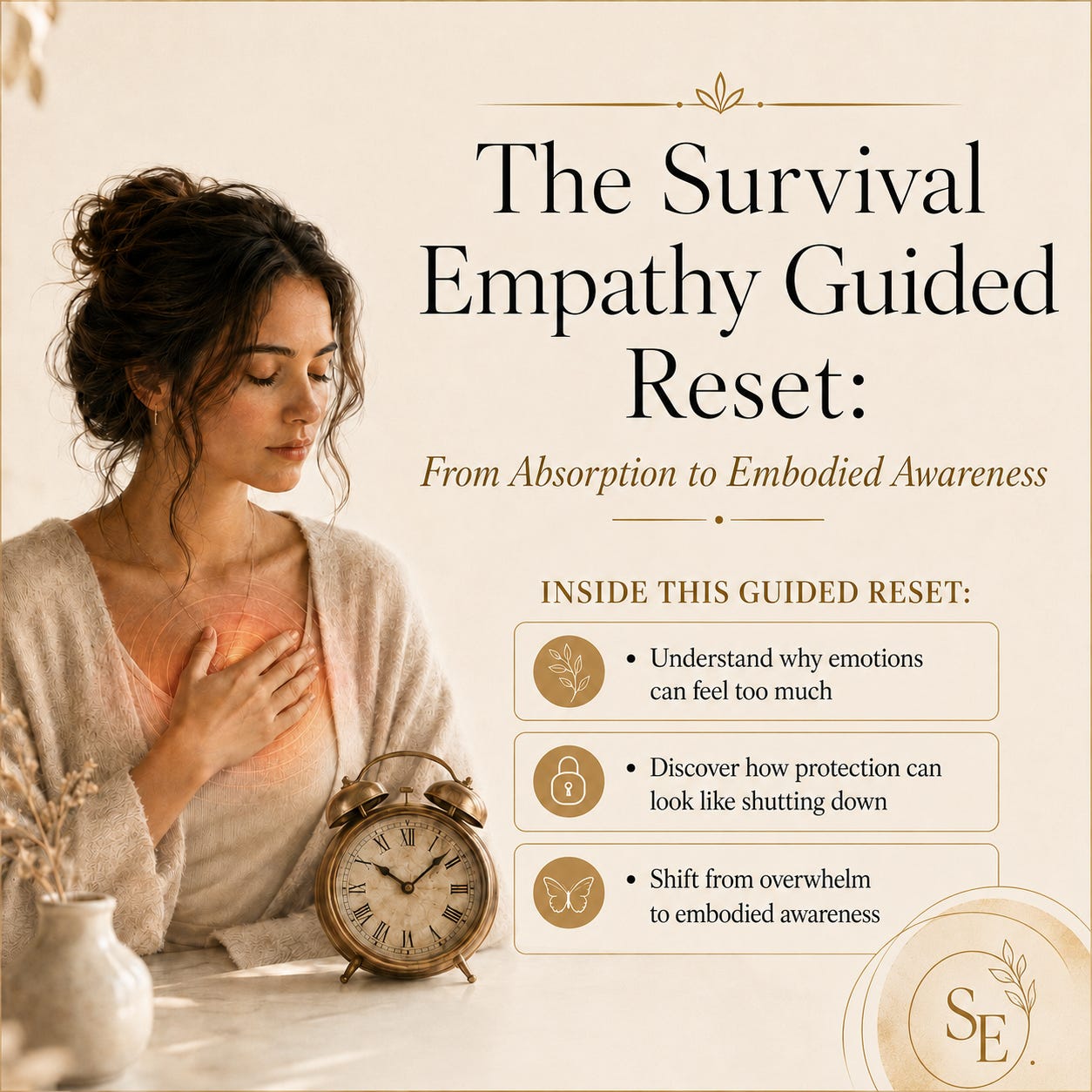
Paid subscribers can get the resource: The Survival Empathy Guided Reset: From Absorption to Embodied Awareness
If you are woman who recognises yourself in this process and finds that integration happens more easily in shared spaces, I have just started a free community on Skool called The Feminine Field. It is a quiet, reflective space for sensitive and neurodivergent women who are interested in weaving psychological understanding with spiritual awareness, embodiment, and nervous system safety. There is no pressure to perform, participate constantly, or be a certain way. It exists as a place to land, reflect, and gently explore what it means to live with more attunement to the body, intuition, and inner rhythms, alongside others who understand that depth and sensitivity are not things to fix, but capacities to work with . Click the image below to join.

This kind of trauma is what I hold space for on my Beyond Betrayal retreat - coming up next year. Not only the betrayals of partners or friends, but the more covert, bone-deep ones, the ones that happen in childhood, under the guise of care. When love is conditional on illness, when attention comes only through suffering, when truth is gaslit by those meant to protect you, the wound goes deeper than words. At this retreat, we don’t just name what happened. We disentangle love from control, care from harm, and begin the slow, embodied process of trusting ourselves again. This is where we reclaim the right to feel well, to be free, and to belong to our own body. Even and especially when we were taught that wellness was a threat.
At my Beyond Betrayal Retreat, we explore the hidden places where the wound lingers, not just in memory, but in behaviours.
We ask:
What are you holding onto… that is holding you hostage?
What would it mean to let go on your own terms?
How can we make meaning out of what felt meaningless?
If you’ve found yourself surrounded by things but starved of safety, this retreat is your invitation to come home — not just to your body, but to your voice, your boundaries, and your worth.
It’s not about blaming the past, it’s about coming back to the one who was silenced: you.
It’s where we stop echoing other people’s stories and start listening to our own.
Through guided somatic work, storytelling, ritual, and re-mothering practices, we will gently call back the voice that learned to stay quiet in order to stay safe.
We’ll move through the nervous system imprints of betrayal not just relational betrayal, but the betrayal of self-abandonment and begin the sacred process of re-alignment.
If this article stirred something in you… if you felt the ache of recognition… if your voice still trembles when you speak your truth, then this retreat is for you.
In 2026, I’m opening sacred space for those ready to step out of the story of betrayal and into something deeper: truth, repair, and return.
We’ll gather in the Scottish Highlands among lochs, firelight, and fierce tenderness, to release what you were made to hold, and remember who you were before the rupture.
This isn’t just healing. It’s retrieval.
If your heart whispered “yes” as you read this, you’re invited.
🜂 Register your interest now and be the first to receive the early details when doors open. Click the image below to find out more and let the wilderness hold what the world tried to silence.

If you would like more help on rewriting your script and are open to working at all energetic levels (physical, mental, emotional and spiritual) check out my Shamanic Scripting programme that integrates evidence-based psychology with spiritual healing practices. Click the image below to find out more:

If you don’t want to commit to a subscription consider buying me a coffee to help me help others in my work.
If you would like to read other areas that I write upon I invite you to check out my Rewrite Room where a collection of my most recent articles can be found. Click the image below to enter.

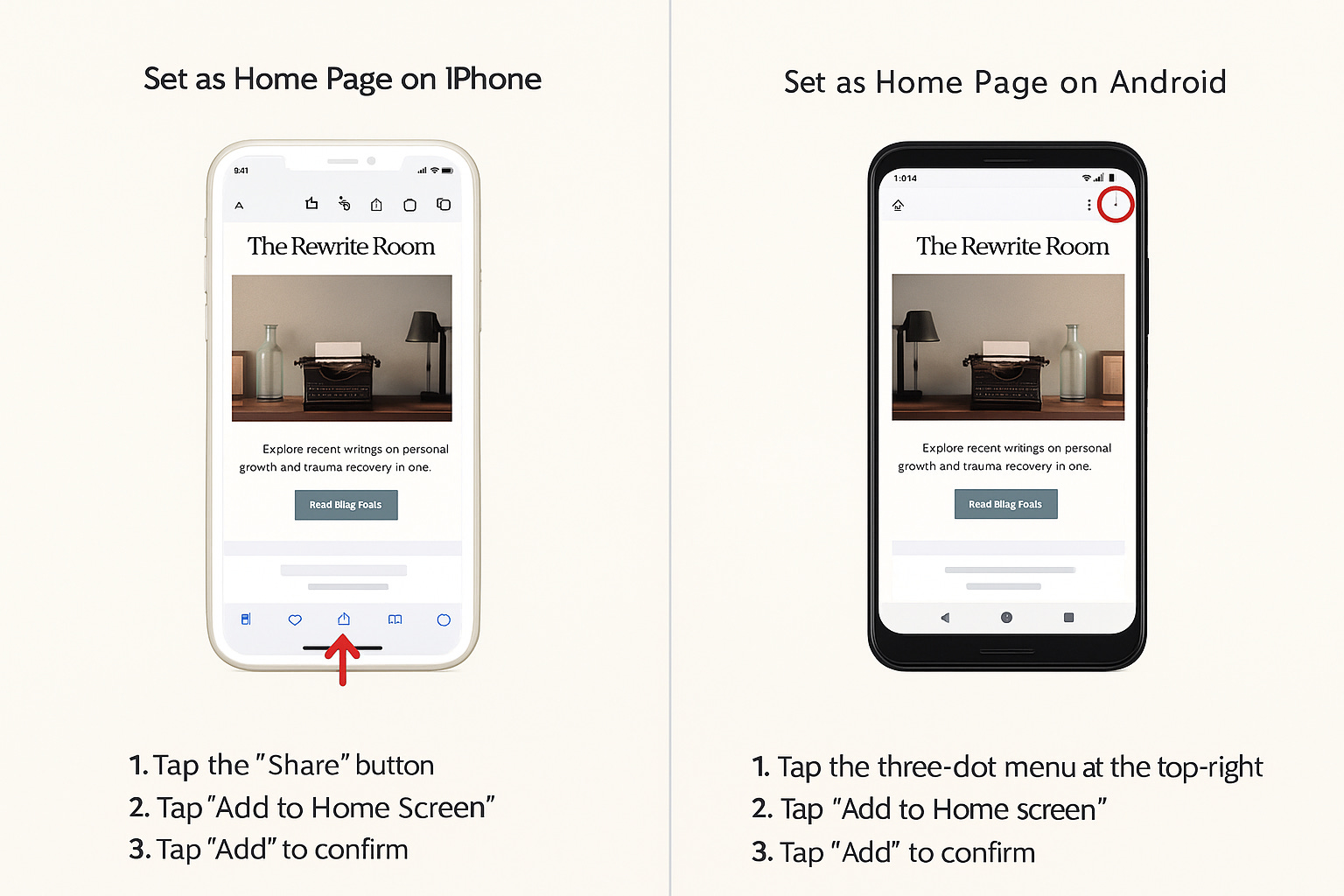
The Rewrite Room is the easiest place to find all of my recent writing in one grounded space. Every new article I publish on Substack and Medium arrives here automatically, so you always have a single doorway to return to. If you enjoy reading my work and want an easy way to reconnect without searching through apps or platforms, you are welcome to keep this page close. Many readers choose to make it their home screen so they can step into this space with one tap. Below is a simple guide on how to do that on iPhone and Android.
To continue to reconnect with your body more and remain mindful and present see if any of these online courses from Rewire Trauma Therapy resonate with you:
Paid subscribers see my code below for 50% off courses over $240 dollars.
Somatic Therapy Programme Link
Expressive Arts For Trauma Healing Programme Link
Healing Trauma-Based Addiction Programme
Healing Trauma Through Sound And Music Programme Link
Nutrition For Trauma ProgrammeLink
Healing Trauma-Based Eating Disorders Programme Link
Trauma-Informed Yoga Programme Link
Healing Trauma Through Movement And Dance Programmme Link
Healing Trauma With Qigong Programe Link
Martial Arts For Trauma Healing Programme Link
Healing Chronic Fear Programme Link
Healing From Narcissistic Abuse Programme Link
Healing From Sexual Abuse And Reproductive Trauma Programme Link
Healing Trauma Through Sleep Programme Link
Psychedelic-Assisted Trauma Therapy Programme Link
Reparent your Inner Child to work on Underlying Trauma
Click the image below to download a self-print
Inner Child Journal for £3.99
