

Betrayal Blindness
How the Mind and Nervous System Hide the Truth To Keep You Safe


The woman we become on the outside is often shaped by the versions of us we could not listen to on the inside. Betrayal blindness is not a failure to see, but a nervous system choosing survival over truth.
Most people imagine betrayal as a sudden moment of realisation, a sharp intake of breath, a clear recognition that trust has been broken. In reality, betrayal is rarely recognised when it is happening. It is often gradual, confusing and obscured beneath layers of loyalty, attachment, responsibility and hope. What people call denial is usually something more complex and more protective. It is betrayal blindness, the state in which your mind and nervous system keep you from fully seeing harm because seeing it would destabilise the very relationship or system you rely on to survive.
Betrayal blindness is not a failure of insight. It is an adaptation. It appears in romantic partnerships, parent child relationships, friendships, workplaces, spiritual communities, therapeutic settings and institutions. It can appear anywhere safety and dependency intersect with harm. It allows a person to stay connected to someone they need, even when that person is violating or diminishing them. It protects the relationship at the expense of awareness because, at the time, protecting the relationship feels essential for survival.
Understanding betrayal blindness requires looking at its psychological roots, its neurobiological mechanics and the way it shapes the nervous system’s responses long after the betrayal is over.
What Betrayal Blindness Really Is
Betrayal blindness is the unconscious suppression of awareness when acknowledging the betrayal would threaten a vital attachment. It is not that the betrayed person lacks intelligence or emotional maturity. It is that their mind is working in the service of survival. The person who is harming them may also be the person who provides financial stability, emotional comfort, protection, belonging, childcare, identity, community or meaning. Admitting the truth would cause overwhelming internal conflict. So the mind chooses partial awareness.
This is the crucial point: the body often knows first. The unease, the tightness, the emotional fatigue, the sense that something is off, the small flinches, the dread that arrives before an interaction. But the mind cannot yet organise these signals into a coherent narrative. Doing so would force a crisis that the system is not yet resourced to handle.
Where dependency is high, awareness becomes dangerous. Betrayal blindness forms to hold the relationship in place.
The Neurobiology of Not Seeing What You See
To understand betrayal blindness, we need to understand what happens in the brain when the person we rely on becomes the person who harms us.
The amygdala, the brain’s alarm system, picks up threat signals quickly. Tone of voice. Facial tension. Sudden shifts in mood. Patterns of inconsistency. The body responds long before the conscious mind does. Heart rate rises. Breath shortens. Muscles tighten. Neuroception, the nervous system’s unconscious safety scanner, notices what the mind refuses to name.
The prefrontal cortex, however, is responsible for reasoning, planning and narrative. When the alarm signals begin, it tries to make sense of them. This is where the conflict emerges. If the alarm is coming from someone you love, need or depend on, the brain begins diluting the information to prevent emotional overload.
Cortisol (stress hormone) levels increase. The prefrontal cortex becomes less effective. The hippocampus, which organises memory, becomes compromised. Details become blurry. Red flags seem less substantial. You might remember the apology more vividly than the betrayal itself. Your brain is structuring your awareness around what feels tolerable, not what is accurate.
This is why betrayal blindness is not stupidity or wishful thinking. It is neurobiology. When the source of comfort and the source of threat are the same person, the nervous system does not know which signal to follow. It chooses the connection, because losing that bond feels like a greater danger than enduring the behaviour. This is how betrayal blindness takes root.
The Nervous System When Love and Threat Come From the Same Person
The autonomic nervous system is designed to help you respond to threat. But it behaves differently when the threat comes from someone you love or depend on. When escape feels impossible and confrontation feels dangerous, the body shifts into fawn or freeze.
Fawn is appeasement. You try harder. You minimise conflict. You keep the peace. You make yourself easier to love. You take responsibility for things that were not yours. You shape shift around their moods.
Freeze is an emotional shutdown. You disconnect from your instincts. You numb emotional signals. You detach to endure the experience without engaging fully with its meaning.
Both states reduce internal conflict. Both protect you from the unbearable truth. And both reinforce betrayal blindness. The nervous system prioritises continued attachment when it believes that losing the attachment would be more dangerous than tolerating the betrayal.
One of the clearest illustrations of why we stay attached to people who hurt us comes from the classic Harlow experiments in the 1950s. Infant monkeys were offered two choices: a wire mother who provided milk and a soft cloth mother who provided no food at all. Even though the wire mother met their physical needs, the infants clung to the cloth mother for hours at a time. They chose the feeling of safety over the source of nourishment.
In later variations, researchers made the soft mother frightening, adding sharp textures or sudden movements, yet the infants still returned to her. The experiments revealed something profound about attachment: the nervous system values connection more than it values comfort, logic or even physical survival. When the figure you rely on for emotional regulation is also the figure who frightens or injures you, the attachment does not break. It strengthens. The infant, and later the adult, moves toward the source of harm because that source is also the source of security.
This paradox sits at the core of betrayal blindness. The body seeks closeness even when closeness is painful, because separation feels more threatening than the hurt. This is not dependency in a moral sense. It is the biology of survival through connection.
Where Betrayal Blindness Shows Up
Romantic relationships
Overlooking lies, minimising emotional cruelty, rationalising manipulation, reframing jealousy as care or staying after violence because you believe the person will change.
Parent-child relationships
Especially in childhood. Children cannot afford to see caregivers clearly as they need them to survive. The blindness may persist into adulthood, long after the original dependency is gone.
Friendships
Excusing humiliation, tolerating inconsistency, ignoring resentment or feeling responsible for maintaining the relationship even when it drains you.
Workplaces
Accepting inappropriate behaviour, exploitation or gaslighting because your income or career stability is tied to the organisation.
Spiritual or therapeutic relationships
Deferring to authority figures, overriding discomfort and believing your resistance is a sign of your own inadequacy rather than a boundary violation.
Institutions
Remaining loyal to communities or organisations even when they harm, exclude or betray you, because belonging feels essential.
In every setting, betrayal blindness follows the same formula: dependency plus threat equals suppressed awareness.
How Betrayal Blindness Shapes Self Betrayal
Over time, betrayal blindness stops being only about the other person. It becomes internal. When you override your instincts long enough, you begin to distrust your own emotional signals. You apologise for things that are not yours. You shrink to avoid conflict. You convince yourself that your needs are unreasonable. You internalise the logic of the betrayer. Self betrayal becomes a learned way of maintaining relational stability. This is one of the most painful consequences. Even when the betrayer is gone, the internalised patterns remain.
Recognising When You Are Living Inside Betrayal Blindness
So if we are blind, how might we see? Because betrayal blindness operates like a fog rather than a wall, the signs are subtle. They include:
• feeling uneasy but explaining it away
• defending someone whose behaviour repeatedly hurts you
• blaming yourself for their actions
• feeling relieved when they are kind again
• forgetting or downplaying harmful incidents
• feeling guilty for setting boundaries
• experiencing dread before interactions
• feeling tired around them
• sensing confusion when others point out concerns
• thinking you are overreacting while your body reacts strongly
A strong sign is when you react to someone describing your situation with more concern than you allow yourself to feel. The body tells the truth before the mind can organise it. You may feel tension, digestive upset, headaches or frequent colds for example.
Why Women Still Miss It Even When They Are Psychologically Literate
Women are socially conditioned to prioritise connection, attunement and emotional labour. Many have developmental histories that rewarded self-sacrifice and punished self-protection. This makes the fawn response more accessible and more socially accepted. A woman may rationalise her partner’s behaviour, not because she is unaware, but because she has been trained to preserve harmony even at her own emotional cost.
Trauma-informed women often understand their partner’s wounds so well that they excuse behaviour they would never tolerate from someone else. Insight does not eliminate vulnerability to betrayal blindness. In some ways, it deepens it.
What Happens When Betrayal Blindness Begins To Lift
When the nervous system finally feels stable enough, the truth begins to rise. This lifting is often disorienting. Women describe sudden moments of clarity followed by waves of grief, anger or shame. They replay past incidents with new context. They notice patterns they missed. They feel emotions that were inaccessible at the time.
This stage can be painful, not because the person is going backwards, but because they are strong enough to metabolise what they could not process before. The thawing of awareness is a sign of healing, not regression.
The Long Shadow of Betrayal Blindness After You Leave
One of the most misunderstood aspects of betrayal blindness is its longevity. Leaving the harmful relationship or environment does not switch off the internal adaptations that formed in order to survive it. Many women expect that once they have physically removed themselves from the dynamic, their clarity will return and their nervous system will settle. Yet the imprint of betrayal blindness remains long after the betrayer is gone.
During betrayal, the mind develops specific ways of interpreting reality that allow it to maintain attachment. These patterns become ingrained. Even years after leaving, a woman may still override her instincts, doubt her perception, or accommodate others beyond what is healthy because these behaviours were once necessary for emotional safety.
I often meet women who left a harmful relationship a decade earlier, yet still find themselves hesitating to express needs, shrinking from conflict, or mistrusting their own sense of what feels right. They say things like, “I function well, but something in me has never fully settled,” or “I left him, but I still feel like I am negotiating with ghosts.”
These patterns persist because betrayal blindness is not just psychological. It is neurobiological. The nervous system learned to associate clarity with danger. It learned to equate self protection with conflict. It learned that intuition leads to disruption. Re teaching it takes time, consistency and active support.
As safety accumulates, many women begin to experience delayed emotional responses. Grief emerges years later. Anger becomes accessible. Memories regain their detail. Episodes that were once minimised become clearer. This delayed awareness is often confusing. Women wonder why things hurt more now than they did then. The answer is simple. The nervous system finally has the capacity to process what happened. This is progress, not regression.
These lingering effects are precisely why my deeper work, including the betrayal retreat (outlined below this article), is designed for women who are no longer in danger but are still living with the aftershock.
What Helps Betrayal Blindness Release Safely
For betrayal blindness to soften, the system must feel safe enough to tolerate clarity. This happens gradually, not through confrontation, but through building capacity.
Safety outside the original relationship is crucial. This might involve therapy, grounded friendships, stable environments or communities that reflect back the reality you could not see before. As external safety grows, internal clarity becomes less threatening. If the betrayal occurs in childhood, it is often much later in adulthood that processing occurs.
Working with the body is essential. Nervous system regulation, trauma-informed breathwork, somatic grounding and gentle movement practices help stabilise the system so that awareness becomes manageable rather than overwhelming.
Journalling can be helpful, not as a record of events but as a record of your internal responses. Over time you begin to see what your body has been trying to say despite the mind’s narrative.
It is also important to separate awareness from action. Seeing the truth does not require immediate decisions. Many women consciously recognise betrayal long before they are ready to confront or restructure their lives. Awareness is a stage of healing in itself.
Rebuilding After Betrayal Blindness: Moving From Survival to Self-Trust
Healing betrayal blindness is not just about understanding what happened. It is about reorganising your internal world so that your nervous system no longer operates on outdated survival patterns. This is slow, steady work. You learn to recognise your body’s signals again. You learn to identify which fears belong to the past. You build new relational templates. You reconnect with intuition. You become able to trust your own perception without immediately second-guessing yourself.
Over time, the nervous system updates. It begins to respond to the present rather than the memory of the past. You stop orienting toward danger. You stop organising your behaviour around someone else’s unpredictability. You begin to feel solid inside your own life.
Paid subscribers can get the resource: The Betrayal Blindness Map.
This kind of trauma is what I hold space for on my Beyond Betrayal retreat - coming up next year. Not only the betrayals of partners or friends, but the more covert, bone-deep ones, the ones that happen in childhood, under the guise of care. When love is conditional on illness, when attention comes only through suffering, when truth is gaslit by those meant to protect you, the wound goes deeper than words. At this retreat, we don’t just name what happened. We disentangle love from control, care from harm, and begin the slow, embodied process of trusting ourselves again. This is where we reclaim the right to feel well, to be free, and to belong to our own body. Even and especially when we were taught that wellness was a threat.
At my Beyond Betrayal Retreat, we explore the hidden places where the wound lingers, not just in memory, but in behaviours.
We ask:
What are you holding onto… that is holding you hostage?
What would it mean to let go on your own terms?
How can we make meaning out of what felt meaningless?
If you’ve found yourself surrounded by things but starved of safety, this retreat is your invitation to come home — not just to your body, but to your voice, your boundaries, and your worth.
It’s not about blaming the past, it’s about coming back to the one who was silenced: you.
It’s where we stop echoing other people’s stories and start listening to our own.
Through guided somatic work, storytelling, ritual, and re-mothering practices, we will gently call back the voice that learned to stay quiet in order to stay safe.
We’ll move through the nervous system imprints of betrayal not just relational betrayal, but the betrayal of self-abandonment and begin the sacred process of re-alignment.
If this article stirred something in you… if you felt the ache of recognition… if your voice still trembles when you speak your truth, then this retreat is for you.
In 2026, I’m opening sacred space for those ready to step out of the story of betrayal and into something deeper: truth, repair, and return.
We’ll gather in the Scottish Highlands among lochs, firelight, and fierce tenderness, to release what you were made to hold, and remember who you were before the rupture.
This isn’t just healing. It’s retrieval.
If your heart whispered “yes” as you read this, you’re invited.
🜂 Register your interest now and be the first to receive the early details when doors open. Click the image below to find out more and let the wilderness hold what the world tried to silence.

If you would like more help on rewriting your script and are open to working at all energetic levels (physical, mental, emotional and spiritual) check out my Shamanic Scripting programme that integrates evidence-based psychology with spiritual healing practices. Click the image below to find out more:

If you don’t want to commit to a subscription consider buying me a coffee to help me help others in my work.
If you would like to read other areas that I write upon I invite you to check out my Rewrite Room where a collection of my most recent articles can be found. Click the image below to enter.

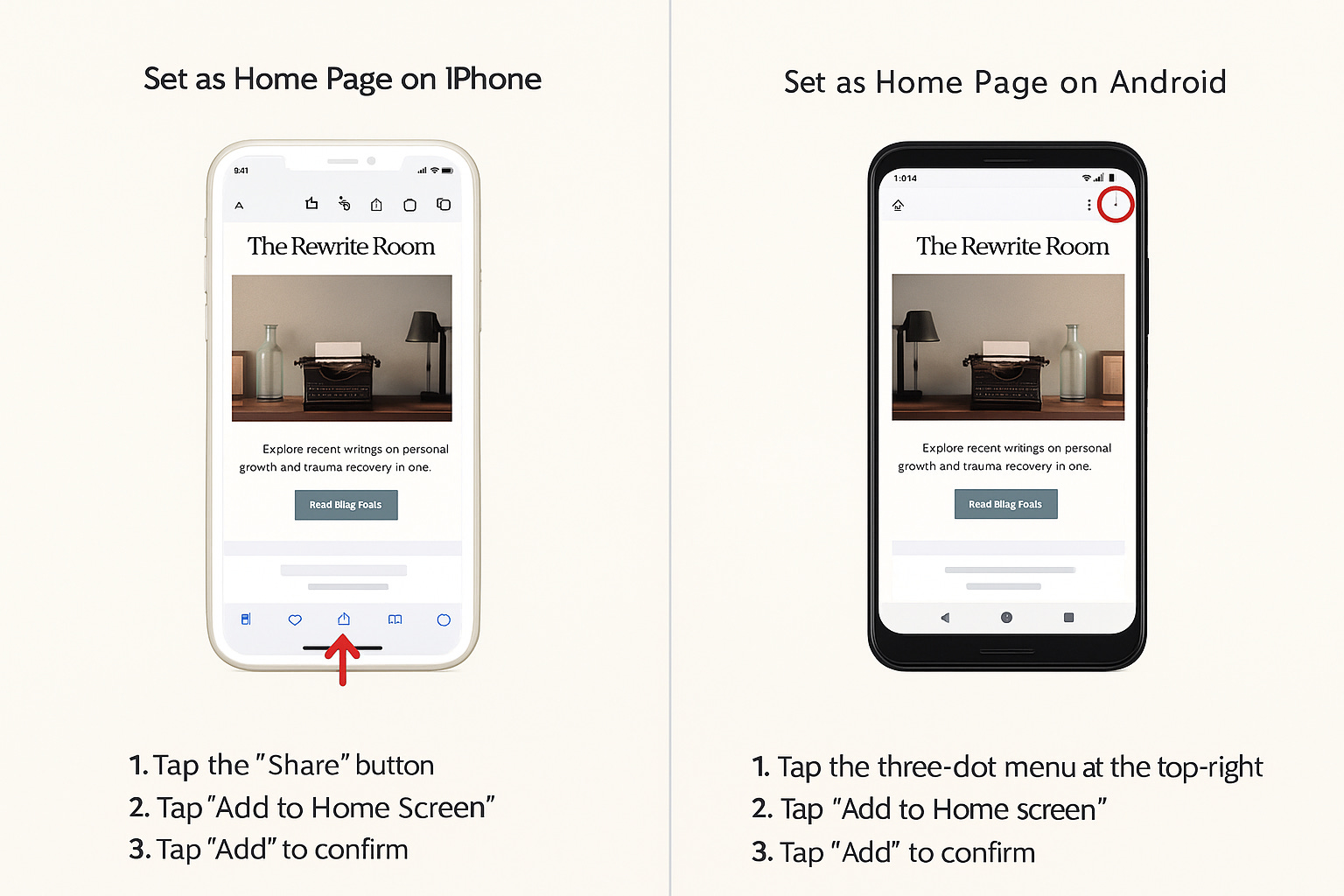
The Rewrite Room is the easiest place to find all of my recent writing in one grounded space. Every new article I publish on Substack and Medium arrives here automatically, so you always have a single doorway to return to. If you enjoy reading my work and want an easy way to reconnect without searching through apps or platforms, you are welcome to keep this page close. Many readers choose to make it their home screen so they can step into this space with one tap. Below is a simple guide on how to do that on iPhone and Android.
To continue to reconnect with your body more and remain mindful and present see if any of these online courses from Rewire Trauma Therapy resonate with you:
Paid subscribers see my code below for 50% off courses over $240 dollars.
Somatic Therapy Programme Link
Expressive Arts For Trauma Healing Programme Link
Healing Trauma-Based Addiction Programme
Healing Trauma Through Sound And Music Programme Link
Nutrition For Trauma ProgrammeLink
Healing Trauma-Based Eating Disorders Programme Link
Trauma-Informed Yoga Programme Link
Healing Trauma Through Movement And Dance Programmme Link
Healing Trauma With Qigong Programe Link
Martial Arts For Trauma Healing Programme Link
Healing Chronic Fear Programme Link
Healing From Narcissistic Abuse Programme Link
Healing From Sexual Abuse And Reproductive Trauma Programme Link
Healing Trauma Through Sleep Programme Link
Psychedelic-Assisted Trauma Therapy Programme Link
Reparent your Inner Child to work on Underlying Trauma
Click the image below to download a self-print
Inner Child Journal for £3.99
